A Glimpse at the Coming Death Panels in the U.S.A.

Newsweek, September 21, 2009

We all knew that the Affordable Health Care Act, popularly known as Obamacare, would lead to lead to rationing. Shortly after Barack Obama became President, he and Nancy Pelosi began promoting such reforms–to redistribute a shrinking pie more equitably. Instead of doctors and patients, or even insurance companies, deciding who would receive medical care, when they would receive it, and how much they would receive, there will now be 160 panels of bureaucrats whose primary mission is to reduce health care costs to the government.

As 2014 approaches, what Sarah Palin called “death panels” are starting to take shape. In this recorded interview with Mark Levin, Jeff, a neurosurgeon, describes what it will mean for his profession.

“If someone over 70 years old has a bleed on the brain in the middle of the night, I have to wait for a panel in Washington to tell me whether I can operate…. I’ve been 9 years in medical school and 10 years in training and now I’ve got people who don’t know a thing about what I am doing telling me when I can or cannot operate.” Without special permission to operate, the new prescription for a bleed on the brain for people over 70 years of age will be “comfort care.” Such decisions will not be determined by a doctor’s evaluation of whether a surgery would provide the patient with many more years of a high quality life; they will be a death sentence.

Continue reading

Posted in Articles | 7 Comments

The Presumption of Reason

In this address, perhaps the last such paper he wrote, Professor Hayek elaborates on the relationship between the evolution of the moral order and evolution of reason, arguing that the latter is dependent on the former, and that rationalists, like Marx and others, who try to construct a social order based on reason (just a small portion of the spontaneous social order) are doomed from the start. Hayek could be considered a pioneer in the field of Integral Political Economy, although he didn’t use that term. His approach is interdisciplinary and integrates scientific and historical approaches to knowledge.

The Presumption of Reason1

F.A. Hayek on receiving the ICUS Founder's Award

F. A. Hayek

Prepared for the Plenary Address, 14th International Conference on the Unity of the Sciences, Houston, Texas, 1985.  © 1986, International Cultural Foundation, Reprinted with permission.

The relationship between the theory of evolution and the development of culture raises a number of highly interesting questions, to many of which economics as a science provides philosophical access that few other disciplines offer.

There has however been great confusion about the matter. So-called social Darwinism, in particular, proceeded from the assumption that any investigator into the evolution of human culture has to go to school with Darwin. This is however quite mistaken. The idea of evolution stems from the theory of lan­guage and from the theory of law, not to mention economics, and long antedated Darwinism. Indeed, not only is the idea of evolution much older in the social sciences than in the natural sciences, but I would even be prepared to argue that Darwin got the basic ideas of evolution from the social sciences. As we learn from his notebooks, Darwin was reading Adam Smith’s The Wealth of Nations at just that time, in 1838, when he was formulating his own theory. In any case, Darwin’s work was preceded by decades, indeed by a century of research concern­ing the rise of highly complex spontaneous orders (such as the market order, and other institutions and traditions) through a process of evolution. Even words like “genetic” and “genetics,” which have today, long after Darwin, become technical expres­sions of biology, were by no means invented by biologists. The first person I know to have spoken of genetic development was the German philosopher and cultural historian Herder. We find the idea again in Wieland, and again in Humboldt. Thus modern biology has borrowed the concept of evolution from studies of culture of older lineage. If this is in a sense well known, it is also almost always forgotten. Continue reading

Posted in Articles, F.A. Hayek | 6 Comments

Fixing “Failed Capitalism” with Principled Rule of Law

Protests Against Capitalism Often Fail to Understand It

Today I was referred to an article in The Times (London) by Matt Ridley titled “Yes, capitalism failed. It’s just too cosy.” What Ridley was criticizing is the “crony capitalism” that reflects our current economic systems in the US and Europe. The Solyndra failure and the housing bubble are archetypical examples of the failure of crony capitalism, where politics and capital investment are too cozy.

Matt Ridley, like many neo-classical economists reminds us that this is not the economics of Adam Smith who was for a free market. Ridley concludes by stating that “capitalism represents the interests of the rich, whereas the market represents the interests of the poor.”

Continue reading

Posted in Articles, Economics, F.A. Hayek, Government | 1 Comment

Government and Unions: Where’s the Referee?

The culture war in the United States can be compared to one big labor dispute between employers and workers. When the 20th Century began, the United States was in the middle of a great growth of industry, and there were many industrial labor disputes. These disputes occurred in the private sector, between capital and labor. These disputes were settled by governors and courts and eventually legislation was passed that legalized private unions and placed limits on the use of power of both parties, so that labor disputes could be settled peacefully. Government served its proper role of creating rule of law and serving as a referee.

Today the situation has changed. The big labor dispute is between government unions and taxpayers. They battle it out between political parties that represent factions, with Democrats shouting “the rich need to pay their fair share,” and the Republicans repeating the phrase “no new taxes.” If a member of either party gets elected as a governor or president, he (she) is expected to represent the partisan position of the party that elected them. In no case will the government get a leader in the position to settle the dispute, one that sees both the vices and virtues of both sides. We have to ask, “Where is the referee?”

Continue reading

Posted in Articles, Economics, Government | Leave a comment

FDA gives patent on public domain gout drug

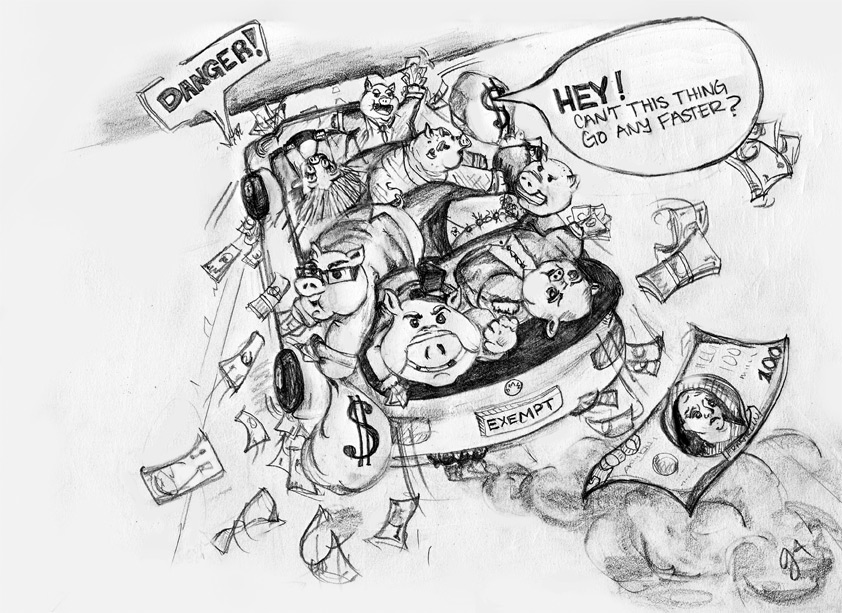
The corruption in US regulatory agencies has reached a new milestone as the FDA gave URL Pharma the sole right to sell Colcrys (colchicine), a drug used to treat gout for thousands of years. Now the price of the drug has increased from $34.83 for 60 tablets to $306.86 for 60 tablets. This problem, exposed by CBS 60 Minutes, exemplifies the ever more urgent need for US regulatory agency reform that I wrote about in April 2010. We are heading down a road that can lead the FDA to authorize one company to sell all drinking water.

This blatant conflict of interest between a corporation and the agency supposed to regulate it has turned the FDA into a pipeline for favors to friends that turns US citizens into their unwitting slaves. Ending such conflicts of interest created by regulatory agencies can greatly reduce the cost of health care in the United States, in this case nearly 10 times. Ironically, many of the proposed “solutions” provided in Obamacare rely on creating similar agencies lacking proper checks and balances that will only increase prices and divide the spoils of such a corrupt system among a few more foxes. Continue reading

Posted in Articles | 2 Comments