People use special interest politics to pressure lawmakers to obtain things for their group. This is not good governance but a form of war by other means. It is a group contest over resources and power. Good governance, on the other hand, is a system based on principles that enables all people to pursue life, liberty, and happiness without any group receiving special treatment.
In societies that are larger than face-to-face communities, freedom and the pursuit of happiness must be defined by principles that transcend communal norms. Communal norms are relative to the community in which they evolved. Articulating principles that transcend communal consciousness is the third stage of social consciousness, the first stage being command, and the second being virtue, both which derive from the shared values of a particular social group. Principles derive from experimentation and reason. They transcend, but generally do not negate, the commands and virtues that allowed cultural groups to evolve to that point.
For example, “thou shalt not steal” is a command, but it is consistent with the more universal economic principle of “protection of private property” that evolved through the cultural experience of almost all civilizations that lasted a long period of time. The success of cultures that protect private property vs. those that do not can be compared and the principle derived from observed success. However, rationalists often promote rationalism with religious fervor, and try to discard the commands and virtues in the inherited culture. The French Revolution is the classic example of attempting to, as Ken Wilber frequently says, “throw the baby out with the bathwater.” Human behavior is largely non-rational, and is formed in stages that include following rules (commands) and mimicking role models (habituating virtues). However, principles derived by reason can place important checks on arbitrary rules and behavior that may appear good in a limited context but are not universally valid.
Principles provide a framework in which individuals of a plurality of cultural backgrounds can find common ground. The United States Constitution provides for the regulation of government through the consistent application of several principles with the intention to provide freedom for individuals to pursue life, liberty, and happiness. These principles did not nullify the traditional religious life of Americans, but enabled plural cultural groups, each with their own social conventions and norms, to live together harmoniously.
A collision often occurs when individuals at one stage attempt to oppose individuals at another stage of social consciousness. The strife between religious fundamentalists and rationalists reflects the trauma involved when the evolution from the traditional phase to the rational phase is not smooth.
When I say that the conservative lacks principles, I do not mean to suggest that he lacks moral conviction. The typical conservative is indeed usually a man of very strong moral convictions. What I mean is that he has no political principles which enable him to work with people whose moral values differ from his own in which both can obey their convictions. It is the recognition of such principles that permits the coexistence of different sets of values that makes it possible to build a peaceful society with a minimum of force.
—F.A. Hayek, The Constitution of Liberty (1959), pp. 401-402.
Three Spheres of Society:
- Government: Basic Principle is Force, Purpose is rule of law
- Economy: Basic Principle is (reason) Market, Purpose is Creation and Exchange of Wealth
- Culture: Basic Principle is Love, Purpose is social cohesion
Principles of Governance:
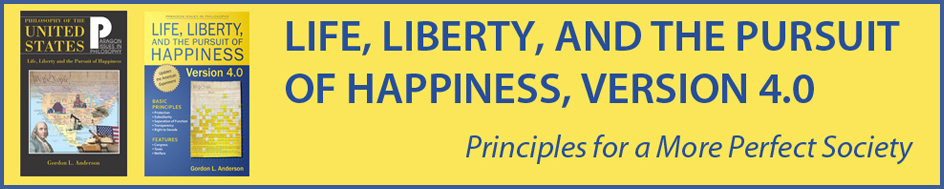
Five basic principles of good governance apply to all social institutions. These are discussed in detail in Life, Liberty and the Pursuit of Happiness, Version 4.0.
- Protection
- Subsidiarity
- Separation of Function (includes checks and balances)
- Transparency
- The Right to Secede
All pending legislation can be checked against these five principles to determine whether it is the introduction of a “worm.” This check is analogous to what anti-virus software does to check for computer worms.
Economic Principles:
- The driving force of an economy is individual pursuit of happiness.
- Protection of private property
- Right to the fruits of one’s labor
- The market rewards production with win-win results
- Governments should plan for competition
- Taxes that do not play favorites
- Regulation based on science rather than fear or cronyism
- Government borrowing that obligates citizens involuntarily is form of involuntary slavery and a violation of fundamental human rights.
Cultural Principles:
- The family is the school of compassion, the desire to produce, and self-regulation, because these qualities come from mimicking behavior of early role models.
- Treat others as an ends in themselves, not as merely a means to another’s ends.
- Do Unto Others as You would have them Do Unto You.
- All people grow through stages, and need care in some stages and are caretakers in others.
- Balance, or “the middle path.”
- There is a higher power in the universe than human-made institutions.

Comments
Principles — No Comments
HTML tags allowed in your comment: <a href="" title=""> <abbr title=""> <acronym title=""> <b> <blockquote cite=""> <cite> <code> <del datetime=""> <em> <i> <q cite=""> <s> <strike> <strong>